
Neuroanatomical Signatures of Obesity Linked to Delay Discounting Impulsivity
Researchers employed a large-scale dataset and two-stage machine learning framework to identify neuroanatomical signatures of obesity and evaluate their associations with delay discounting impulsivity in young adults.
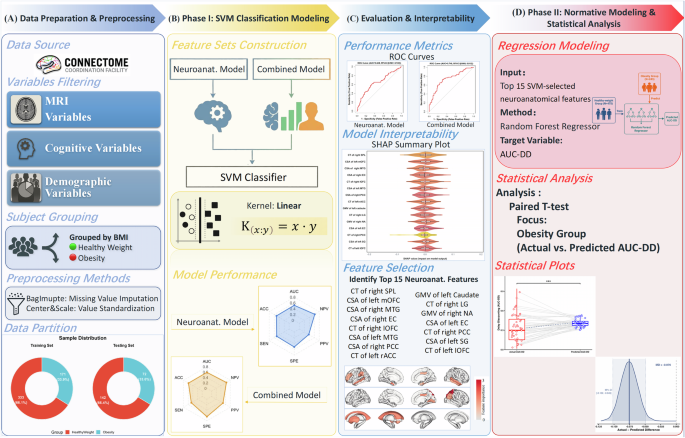
Prior obesity neuroimaging studies often relied on univariate methods and small sample sizes, which frequently limited the reproducibility of findings. To address these constraints, researchers utilized a large-scale dataset from the Human Connectome Project to identify robust neuroanatomical signatures associated with obesity. This approach allowed for a more reliable evaluation of population-level associations between brain structure and behavioral traits such as delay discounting impulsivity.
The study employed surface-based morphometry to extract cortical surface area, cortical thickness, and subcortical gray matter volume from the 243 young adults with obesity and 475 healthy-weight controls. A two-stage machine learning framework was implemented, utilizing support vector machine (SVM) classifiers to discriminate between obesity and healthy weight based on neuroanatomical features. Interpretability of these models was assessed using SHapley Additive exPlanations (SHAP), while partial correlations evaluated associations between selected features and delay discounting impulsivity.
The SVM classifier achieved a receiver operating characteristic (ROC-AUC) of 0.648 using neuroanatomical features alone. When demographic and cognitive covariates were added, the ROC-AUC improved to 0.740. SHAP analysis highlighted the superior parietal, entorhinal, medial orbitofrontal, posterior cingulate, and rostral anterior cingulate cortices as key discriminators. Ten of the top 15 features showed significant associations with delay discounting impulsivity in the expected direction.
The obesity group demonstrated systematically higher delay discounting impulsivity than predicted by brain structure-based expectations alone. These findings suggest that distributed neuroanatomical features across prefrontal, medial temporal, cingulate, and parietal cortices discriminate obesity and correlate with impulsivity across group, correlational, and normative analyses. The study provides a reproducible framework for linking neuroanatomical signatures to behavioral phenotypes in metabolic research contexts.